

Tea Specialist: 5 Reasons Coffee Won't Work For Morning Focus
A certified tea specialist went looking for a better morning cup for her 71-year-old sister. What she found in the research on a little-known amino acid changed what's in both their kettles.

The teapot came out of the cupboard on a Tuesday in April.
It's cobalt blue porcelain, my mother's, with a chip on the spout she always turned toward the wall. I hadn't used it in years.
But the morning the new tea arrived, I stood at my kitchen sink in Calvert City, Kentucky, with a soft cloth and a pinch of baking soda. I polished that pot until the blue came back.
Outside, the dogwoods were opening along the road. Inside, the kettle had started to tick.
Mama's pot, a brand-new leaf. Let's see what you can do.
I'll tell you what happened in that cup. But first I want to ask you a few things, because your answers are the reason I went looking.
Do you ever walk into a room... and stand there, wondering what you came in for?
Do you reach for a word you've used ten thousand times, and it just sits there on the tip of your tongue?
Have you put your keys down "somewhere sensible" and then spent twenty minutes touring your own house?
Or do you sit down with the crossword, the sewing pattern, or the checkbook after breakfast and feel like your mind is still in bed?
If you nodded at any of those, I want you to know something.
You're not alone. Not even close.
Every morning, MILLIONS of Americans pour a cup of coffee and hope it will do the one thing they really want it to do: get their head in the game.
How many millions? The National Coffee Association puts it at two-thirds of American adults, 66 PERCENT, drinking coffee every single day. [1]
That's more people than vote in most elections. All of them spinning the same wheel every morning.
And for a lot of us past 60, it just... doesn't.
Not the way it used to.
Not without the shaky hands.
Not without that 2 o'clock slump that feels like somebody pulled the plug.
My name is Margaret Hollis. I'm a certified tea specialist and a wellness writer, and for the last eleven years I've made my living tasting, grading and writing about tea leaves.
If you've never met a tea specialist, here's what the job looks like. I sit at a long table with a row of white cups, I steep each leaf for exactly the same time, and I slurp, loudly, the way you're told not to at dinner.
I grade the leaf, I write down the color of the cup, and I tell importers and small blenders whether what they've got is worth the price they want for it.
Over eleven years, that's thousands of cups. It makes you very hard to impress... and very quick to notice when a tea is doing something the others don't.
But this article isn't really about me. It's about my older sister, Ruth.
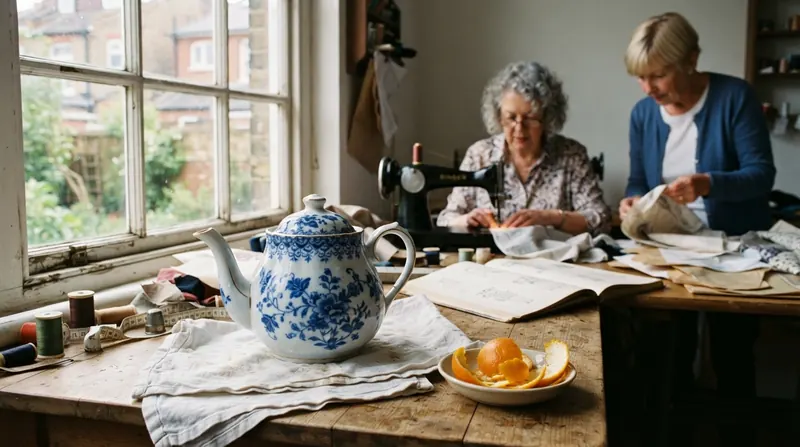
Ruth is 71. She spent forty years as a bridal seamstress in Paducah, Kentucky, and she can still thread a needle faster than I can find my reading glasses.
Last spring she called me from her sewing workshop. She didn't say hello.
"Peg, I feel foggy till noon."
Nobody else calls me Peg. Nobody else gets to.
"Foggy how?" I asked her.
"Like my hands are awake and the rest of me is still under the quilt."
That phone call sent me down a research path I didn't expect. What I found is the reason this page exists.
So pour yourself something warm. I'm going to tell you why coffee lets so many of us down in the morning... and what I put in Ruth's kettle instead.
Why "Just Have Another Cup" Is Terrible Advice
Here's the thing nobody mentions about coffee.
It's not that caffeine doesn't work. Caffeine absolutely works.
The US Food and Drug Administration says plainly that caffeine in moderate amounts increases alertness. [2]
The problem is HOW coffee delivers it.
Think about it. When Ruth makes a pot of coffee, she has no idea how much caffeine is in her mug.
Neither do you. Neither did I, and I taste tea for a living.
The FDA's own consumer guidance puts a single 12-ounce cup of brewed coffee anywhere from 113 to 247 milligrams of caffeine. [2]
Read that again. The SAME size cup can hold more than TWICE the caffeine, depending on the beans, the roast, the grind and how long it sat on the burner.
So one morning you get a pleasant lift. The next morning you get the jitters and a heartbeat you can feel in your ears.
And then you wonder why you can't concentrate.
That's problem number one. There are four more, and they're bigger.
Caffeine By Itself Is NOT The Best Option For Focus
I expected the research to tell me that coffee was fine and Ruth just needed more of it.
It told me the opposite.
In 2008, a team of researchers ran a placebo-controlled crossover trial with 27 healthy volunteers. [3]
They gave the volunteers caffeine on its own. Then, on a different day, caffeine PLUS a second compound that occurs in tea leaves.
Caffeine alone did what you'd expect: at the 60-minute mark the volunteers rated themselves more alert. [3]
But caffeine with that second compound did something different. The volunteers were faster AND more accurate on an attention-switching task... and less likely to be thrown off by distracting information during a memory task at 60 and 90 minutes. [3]
That second compound is called L-theanine.
It is an amino acid found in the leaves of Camellia sinensis, the plant that gives us green, black and oolong tea. [4]
Coffee doesn't have it. Not a trace.
And once I understood that, the five problems with Ruth's morning coffee became impossible to unsee.

There Are 5 MAJOR Problems With Coffee As Your Morning Focus Tool
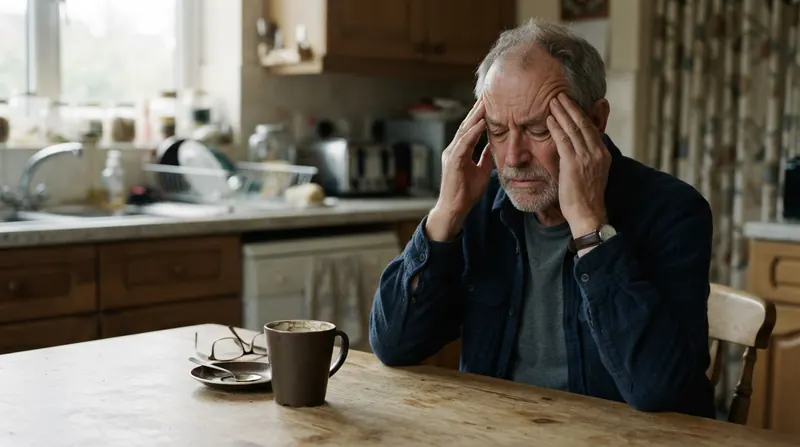
Let me walk you through them one at a time. Each one has a number behind it, and each one is something you can check for yourself.
Problem #1: You never know the dose
I covered this above, but it deserves its own line, because it's the root of everything else.
A 12-ounce cup of brewed coffee holds somewhere between 113 and 247 milligrams of caffeine. [2]
That's not a small range. That's the difference between a pleasant lift and a morning spent re-reading the same paragraph three times.
With coffee, you're not choosing a dose. You're spinning a wheel.
Ruth takes her coffee in the same chipped mug every morning. "Same mug, same scoop," she told me, "so it's the same coffee."
It isn't. The mug was lying to her, and it had been for twenty years.
Every number on that chart comes from the FDA consumer guidance on caffeine, except the refill bar, which is simple multiplication. [2]
Problem #2: Caffeine alone brings the jitters along for the ride
This is the one Ruth knew in her bones.
The FDA lists what too much caffeine can bring: a faster heartbeat, palpitations, jitters, an upset stomach, headache and sleep disruption. [2]
Sound familiar?
That shaky-hand feeling isn't a sign that the coffee is "working." It's a sign that the caffeine went in fast, alone, and with nothing to smooth the edges.
For a seamstress, shaky hands are not a small thing. Ruth told me she'd stopped doing beadwork in the morning because she couldn't trust her fingers until after lunch.
"I do the beads after lunch now," she said, like it was nothing. It wasn't nothing.
Think about what that means. The ONE thing she drank to feel sharper was costing her the hours when she needed to be sharpest.
And here's the cruel part. When the hands shake, most of us assume we need MORE coffee, not less.
So we pour another cup, the jitters get worse, and we blame our age instead of the mug.
Nobody ever told Ruth that the lift and the shake were coming from the same place. Nobody ever tells anybody.
Problem #3: Coffee is missing the ingredient the researchers actually tested
Go back to that 2008 crossover study for a moment. [3]
The caffeine dose they used was modest: 50 milligrams. The L-theanine dose was 100 milligrams. [3]
Caffeine alone improved self-rated alertness at 60 minutes and accuracy on the attention-switching task at 90 minutes. [3]
But it was the COMBINATION that was associated with faster, more accurate attention switching at the one-hour mark... and with being less distractible on a memory task. [3]
In other words, the thing that helped the volunteers switch their attention cleanly wasn't more caffeine. It was caffeine with company.
And coffee, no matter how good the beans, cannot give you that company.
Problem #4: The refill trap
Here's what happens when the first cup doesn't do the job.
You have a second. Then a third, "just to get through the morning."
The FDA cites 400 milligrams a day, about two to three 12-ounce cups, as the amount not generally associated with negative effects in most healthy adults. [2]
Now look back at the chart. Three refills at the high end of that range is 741 milligrams.
That's not a focus plan. That's a heartbeat you can hear.
The European Food Safety Authority drew the same lines in 2015: single doses up to 200 milligrams and daily intakes up to 400 milligrams do not raise concerns for healthy adults. [5]
Notice what both agencies are saying. The amount matters.
And with coffee, the amount is the one thing you can't see.
Problem #5: The afternoon cup steals from your night
This is the quiet one. The one that sneaks up on you.
When the morning cup wears off, a lot of us reach for another one at 2 or 3 in the afternoon.
And the FDA's list of what too much caffeine can bring ends with two words that should give every one of us pause: sleep disruption. [2]
So the afternoon coffee that gets you through the slump... is the same coffee that has you staring at the ceiling at midnight.
And a night like that is exactly how you end up walking into a room tomorrow morning and forgetting why you came.
Four Cups That Didn't Make It Into Ruth's Kettle
I didn't go straight to the tea I'm about to show you. I'm a specialist, so I did what specialists do: I overcomplicated it.
Here's what I put in front of my sister first, and why each one came off the table.
Cup #1: Regular black tea
This was the obvious move. Black tea has L-theanine in the leaf, it's cheap, and Ruth already liked the taste. [4]
The problem was the lift. By the seller's own comparison table, a regular cup of black tea sits around 50 milligrams of caffeine, against about 120 for coffee. [6]
For a woman used to a mug of coffee, that's a whisper. Ruth drank it for four days and went back to the coffee pot without telling me.
Cup #2: Green tea, the "healthy" choice
Everyone's aunt has told them to drink green tea. So I tried that.
Same plant, same amino acid, and even less caffeine than black tea by the seller's table: about 35 milligrams a cup. [6]
Ruth took one sip and set the cup down. "Peg, it tastes like lawn clippings with ambition."
We moved on.
Cup #3: Coffee with a scoop of something
Then I got clever. What if we kept the coffee and just added the missing piece?
That meant buying L-theanine on its own, measuring it with a tiny scoop, and stirring white powder into her coffee every morning.
This is it, I thought. Chemistry, solved at the kitchen counter.
It lasted exactly one week. Ruth is 71 and she does not want a chemistry set next to the sugar bowl.
And it still didn't solve Problem #1. The coffee underneath was the same roll of the dice it had always been. [2]
Cup #4: A "focus" coffee with the amino acid already mixed in
There are coffees sold with L-theanine blended into the grounds. I looked at a few.
They solve the chemistry-set problem, but not the dose problem.
Coffee is coffee. The caffeine in the cup still swings with the roast, the grind and the burner. [2]
And Ruth, for the record, didn't like the taste of any of them.
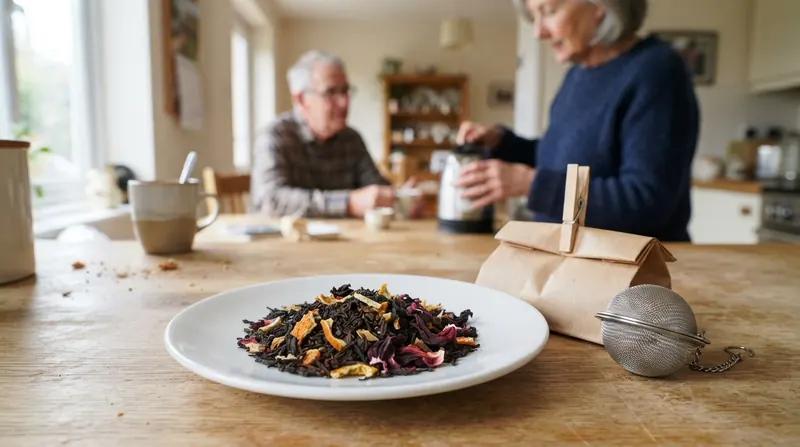
Thanks To A Growing Stack Of Research, We Now Know About A Simpler Morning Cup
So here's where my research took me.
If caffeine alone is the problem, and caffeine WITH L-theanine is what the researchers kept coming back to, then the question becomes obvious.
Where do you get both... in one cup... every morning... without measuring anything out?
The answer has been sitting in tea gardens for a very long time.
Black tea is made from the same Camellia sinensis leaf as green tea, and that leaf is the original source of L-theanine. [4]
But here's the catch. Most black tea is on the lighter side of caffeine.
If you're used to coffee, a standard cup can feel like a whisper.
What I wanted for Ruth was the morning lift of coffee... with the L-theanine of tea... in a single cup she could make with the kettle she already owns.
That's a surprisingly short list of products. And the one that ended up in Ruth's kitchen is a loose leaf black tea blend made by a small company in Baltimore, Maryland.
I'll introduce it properly in a minute. First, I want to tell you where L-theanine came from, because the story matters.
Let's Start On A Hillside In Japan, Under A Canopy Of Shade Cloth

Picture a tea garden on a hillside, three weeks before the spring harvest.
The farmers walk the rows and draw dark cloth over the bushes, blocking most of the sunlight.
It seems backwards. Plants need sun.
Why would you hide a tea bush from it?
Because the farmers had noticed something, generations before any chemist could explain it.
Shaded leaves tasted different. Rounder.
Sweeter, with a savory depth they called umami.
The tea from those shaded bushes was so prized that it was reserved for ceremonies and for the people who could afford it.
It took until the late 1940s for Japanese tea chemists to isolate what was behind that taste. They found an amino acid that no one had described before, and they named it after the plant: theanine.
L-theanine, it turned out, was the compound that made shaded tea taste the way it did.
And for the next half century, it stayed mostly a tea-world curiosity. Something for tasters and growers to argue about.
Then researchers started asking a different question. Not "what does it taste like?" but "what does it do when it's in the same cup as caffeine?"
That is the question the 2008 crossover study set out to answer. [3]
And it is the question a small Baltimore tea company built an entire product line around.
But wait... isn't L-theanine a green tea thing?
This is the question I get most often at tastings, so let me clear it up.
Green, black and oolong tea all come from the same plant, Camellia sinensis. [4]
The difference is what happens to the leaf after it's picked.
Green tea is heated quickly to stop the leaf from oxidizing. Black tea is rolled and allowed to oxidize fully, which is what gives it that deep copper color and malty backbone.
Oxidation changes the color and the flavor. The amino acid comes from the same leaf either way.
So when a tea company tells you its black tea carries L-theanine, it isn't a gimmick. It's the plant. [4]
What black tea gives you that green tea doesn't is a leaf that can stand up to a strong steep and a high caffeine positioning without turning bitter and thin.
That's exactly why a HIGH caffeine black tea was the end of my search. I'd never have found it by sticking with the green tea my aunt swears by.

What The Studies On L-Theanine Actually Found, With The Numbers
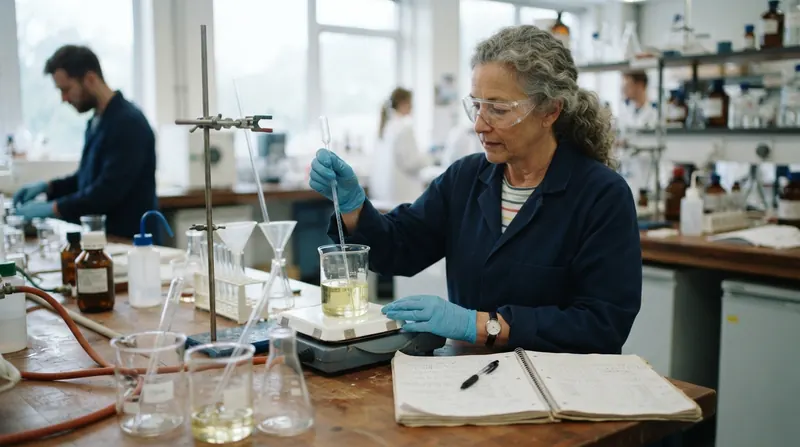
I'm a tea specialist, not a scientist. So when I sat down with the research, I did what I'd want you to do: I read the actual numbers.
Here are the three studies that convinced me to put a different leaf in Ruth's kettle.
Study one: caffeine with L-theanine and the attention switch
You've already met this one. Twenty-seven healthy volunteers, placebo-controlled, crossover design. [3]
Fifty milligrams of caffeine with 100 milligrams of L-theanine. [3]
At 60 minutes: faster AND more accurate on the attention-switching task. At 60 and 90 minutes: less susceptible to distracting information during a memory task. [3]
I want to be fair about the limits, because the researchers were.
It was a single dose. It was 27 people.
And the authors worked for a tea company. [3]
But the pattern was clear enough that other teams went looking for it too.
Study two: four weeks of L-theanine in healthy adults
In 2019, a Japanese team ran a four-week randomized, double-blind, placebo-controlled crossover trial with 30 healthy adults. [7]
Nine men, 21 women, average age 48. Two hundred milligrams of L-theanine a day. [7]
After four weeks, the L-theanine period was followed by better verbal-fluency and executive-function scores. [7]
And here's the detail I found most interesting. Compared with placebo, the verbal-fluency gain showed up in the half of participants who STARTED with the lower scores. [7]
In plain words: the people who had the most room to improve were the ones who did.
Study three: a single dose in adults aged 50 to 69
This is the one closest to home for me, because of the ages.
A double-blind, randomized, placebo-controlled study in Japanese men and women aged 50 to 69, all with normal mental-status scores. [8]
A single dose of L-theanine was associated with a faster reaction time on an attention task... and with more correct answers and fewer omission errors on a working-memory task. [8]
Fewer omission errors. For a woman who had stopped doing beadwork before noon, that line landed hard.
Three studies. Three different designs.
One compound, found in one leaf.
And none of them used coffee.
What People Who Drink This Tea Every Morning Are Saying

Before I tell you about the tea itself, I want you to hear from the people who buy it.
These are reviews published on the seller's own product page, reproduced word for word. The portraits are illustrative.
As of the day I read the page, it showed 4.90 stars across 1,593 reviews. [9]

The Blue Lady Tea Bags are excellent. It is a wonderful morning cup of tea. Great flavor no caffeine crash!

Great taste and no crash!

One of my favorite teas. It's floral like Earl Grey, another favorite of mine.
*Individual results vary. Gigi refers to the tea-bag version of the same blend; this page is about the loose leaf bag.
Notice what two of those three reviewers reached for first.
Not the flavor. Not the price.
"No crash."
That's the loop I described above, Problem #4 and Problem #5, and two strangers describing their way out of it in three words.
What I learned reading 1,593 reviews
I didn't stop at three. Before I put this tea in front of my sister, I sat down one evening and scrolled through the seller's review page until my tea went cold.
I'm not going to quote the rest, because I promised only exact words, and only words I could pin to a name. [9]
But I can tell you what the pattern looked like from where I sat.
People talk about the taste first. Orange, floral, "like Earl Grey," over and over.
Then they talk about the morning. The lift, and what they didn't get along with it.
And a surprising number of them mention the same thing Gigi and Sterling did, in almost the same words: no crash.
Could that be the seller's tagline echoing back? Maybe.
People repeat what they read on the bag.
But 1,593 people don't rate a $22.95 tea 4.90 stars because of a tagline. They rate it that way because they keep buying it. [9]
That's not a study. I know the difference, and I've shown you the real studies above.
It's just 1,593 strangers who had the same question Ruth did, and kept the bag.
Introducing... Blue Lady High Caffeine Loose Leaf Tea
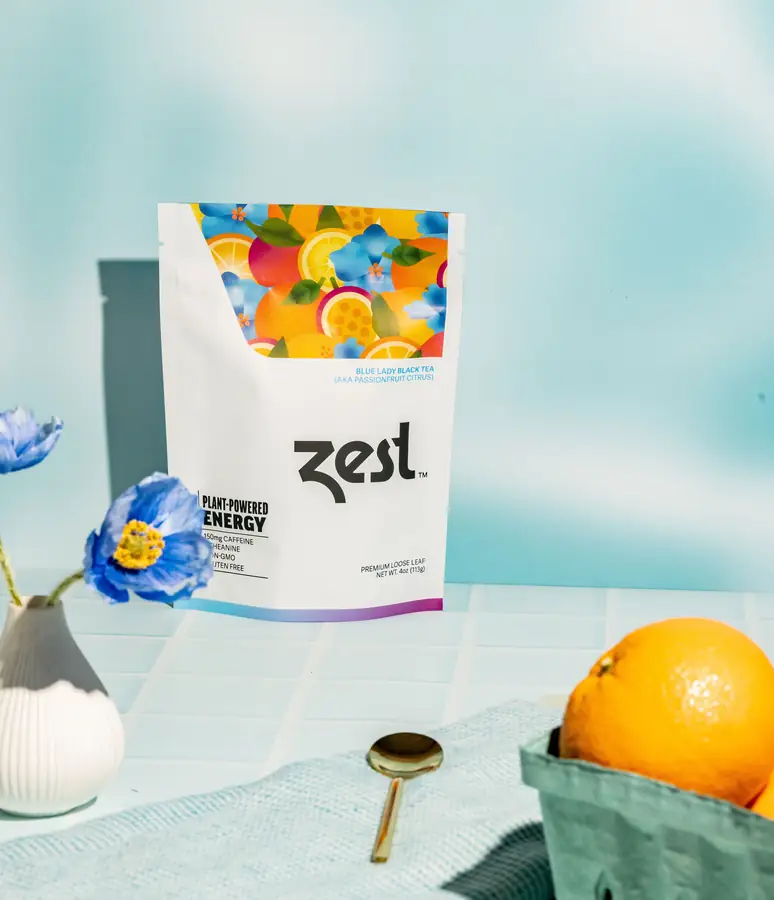
Blue Lady is a loose leaf black tea made by Zest Tea, LLC, a company based in Baltimore, Maryland.
Here is how the seller describes it, in their own words: it "blends a sultry orange pekoe black tea base with an aromatic mix of orange peel, lemon, passionfruit and hibiscus." [9]
And here's the part that made me sit up: the seller positions it as a HIGH caffeine tea, with "more caffeine than coffee," paired with the L-theanine that comes with the tea leaf itself. [9]
How high? The seller's FAQ states that its high caffeine black teas contain 150 milligrams of caffeine per serving. [6]
Compare that with the seller's own figures for a regular cup of black tea, 50 milligrams, and a cup of coffee, 120 milligrams. [6]
So this is not "tea instead of coffee." This is a cup that, by the seller's numbers, out-caffeinates the coffee... from a leaf that brings its own L-theanine.
Let me say what that means in plain English.
You get the morning lift you're used to from coffee. And you get it from a leaf that brings its own L-theanine to the cup.
Not a powder. Not a capsule.
Not a shot.
A cup of tea, made in a kettle, the way your mother made it.
- An orange pekoe black tea base, the sturdy kind of leaf that stands up to a strong steep
- Orange peel, lemon, passionfruit and hibiscus for a bright, floral cup, by the seller's description
- Positioned by the seller as high caffeine: 150 mg of caffeine per serving, by the seller's FAQ [6]
- The L-theanine that comes with Camellia sinensis leaf, the compound in all three studies above
- Loose leaf in a resealable bag, so you measure the strength yourself
- Not a coffee substitute that tastes like dirt and apologies
- Not a supplement: it's tea, a food, and it is not meant for any health problem
- Not caffeine-light: if you're sensitive to caffeine, this is not your cup
- Not a promise about your memory: no tea is, and this page doesn't make one
The seller's own tagline is "No jitters. No crash."
I'm quoting it because it's their claim, not mine, and because it lines up with what two of the three reviewers above wrote unprompted. [9]
What I can tell you as a tea specialist is this.
The leaf is a black tea, the flavoring is fruit and flower, and the caffeine positioning is at the top of the tea world. That combination is rare.
Why I Chose The Loose Leaf Bag Over The Tea Bags
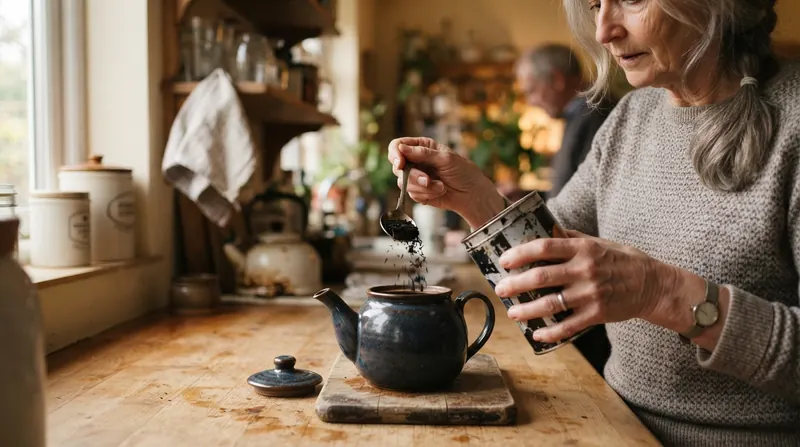
Zest sells this blend two ways: in tea bags, and as loose leaf in a resealable bag. Gigi, the first reviewer above, drinks the bags.
I bought Ruth the loose leaf, and I'd do it again. Here's why.
With loose leaf, YOU decide how strong the cup is. A level spoon for a lighter morning, a rounded one when the pattern on the table is complicated.
With a bag, somebody in a factory decided for you.
Loose leaf also means whole pieces of leaf, peel and petal in the infuser, not the dust at the bottom of a paper pouch. You can see what you're drinking.
And then there's the part I didn't expect to matter: the ritual.
Spooning the leaf, pouring the water, watching the color bloom in the cup. It takes ninety seconds, and in those ninety seconds Ruth isn't scrolling, worrying or hunting for her glasses.
She's standing at her kettle, doing one thing. For a woman whose whole complaint was "foggy till noon," a morning that starts with one unhurried thing is not nothing.
Ninety seconds. That's all the ritual costs, and it's the best ninety seconds of her day.
Loose leaf isn't for everyone, and I say so in the list further down. But if you own a kettle and an infuser, it's the version I'd want in your cupboard.
Why Zest Tea, And Not One Of The Dozen Others
I looked at a lot of "energy teas" before this one. Most of them failed a very simple test: could I find out who made them, and could I reach that person?
Zest Tea passed. Here's what I could verify on their own site, in their own words.
- A company name and a street address: Zest Tea, LLC, Baltimore, Maryland
- A published caffeine figure, 150 mg per serving for the high caffeine black teas, right on the FAQ [6]
- A per-cup comparison table that shows their numbers next to coffee and regular tea, instead of just saying "strong" [6]
- A refund policy short enough to quote in one sentence: 30 days, no questions asked, from the day your package arrives [10]
- 4.90 stars across 1,593 reviews on the product page the day I read it [9]
None of that tells you how the tea tastes. But it tells you that if something goes wrong with your order, there's a company behind it with a door, a phone line and a policy.
After eleven years in this business, that's the first thing I check and the last thing I'd give up.
Can You Picture Yourself This Time Next Month...

Close your eyes for a second and picture a Tuesday morning, four weeks from now.
The kettle clicks off. You spoon the leaf into the infuser, pour, and let it sit while you butter your toast.
The kitchen smells like orange peel and something floral you can't quite name.
You sit down with the crossword. Or the sewing pattern.
Or the stack of mail you've been avoiding.
And instead of reaching for a second cup at 9:30... you just keep going.
No shaky hands when you thread the needle. No re-reading the same clue three times.
Just a warm cup, a clear table, and a morning that belongs to you.
Now picture the afternoon, because that's where the old loop used to catch you.
It's 2:30. The pattern is cut, the mail is opened, and you notice you haven't been to the coffee pot since breakfast.
Not because you were being good. Because you didn't think about it.
And then picture the evening: a cup of something without caffeine, a chapter of a book, and a night that isn't spent counting the ceiling tiles.
That's one Tuesday. String thirty of them together and that's the month.
That's the morning Ruth wanted. It's the morning I wanted for her.
I can't promise it to you. Nobody honest can.
But I can tell you that the research on caffeine with L-theanine is real, the leaf is real, and the kettle is already in your kitchen.
Blue Lady Works Using What Tea Researchers Call "Pairing"
Now, without boring you with the science, all you need to know is this:
Caffeine presses the gas. L-theanine keeps the wheel steady.
That's it. That's the whole idea.
Caffeine on its own does what the FDA says it does: it increases alertness. [2]
But on its own, it also brings the list you've already seen.
Jitters. A racing heartbeat.
An upset stomach. [2]
When researchers paired caffeine with L-theanine, the volunteers were faster and more accurate at switching their attention, and harder to distract. [3]
Same gas pedal. Steadier wheel.
Here's the beautiful part. You don't have to buy the two things separately and measure them into a cup.
The tea leaf already does the pairing for you. It has done it for every cup of black tea ever brewed, because L-theanine is part of the leaf. [4]
The only thing a standard black tea was missing, for a coffee drinker like Ruth, was the caffeine to match.
A high caffeine black tea closes that gap.
The Figures That Matter Most, In One Place
I promised numbers, so here they are, all in one place, all from the sources at the bottom of this page.
- 113 to 247 mg: the caffeine in a single 12-ounce cup of brewed coffee, per the FDA. [2]
- 400 mg: the daily amount the FDA cites as not generally associated with negative effects in most healthy adults. [2]
- 200 mg: the single dose the European Food Safety Authority says does not raise concerns for healthy adults. [5]
- 50 mg + 100 mg: the caffeine and L-theanine doses in the 2008 attention-switching study. [3]
- 60 minutes: when the caffeine-plus-L-theanine group was faster and more accurate at switching attention. [3]
- 200 mg a day, 4 weeks: the L-theanine dose and length of the 2019 trial in 30 healthy adults. [7]
- 50 to 69: the ages in the single-dose study that found fewer omission errors on a working-memory task. [8]
- 150 mg: the caffeine per serving the seller's FAQ states for its high caffeine black teas. [6]
- 66 percent: the share of American adults who drink coffee every day, per the National Coffee Association. [1]
- 4.90 stars, 1,593 reviews: the rating on the seller's page the day I read it. [9]
The chart above is the seller's own comparison table, reproduced as printed. [6]
Put those side by side and a picture forms.
The agencies agree that caffeine works, and that the amount matters.
The researchers agree that caffeine with L-theanine did things caffeine alone did not.
And the customers, in their own words, keep saying "no crash."
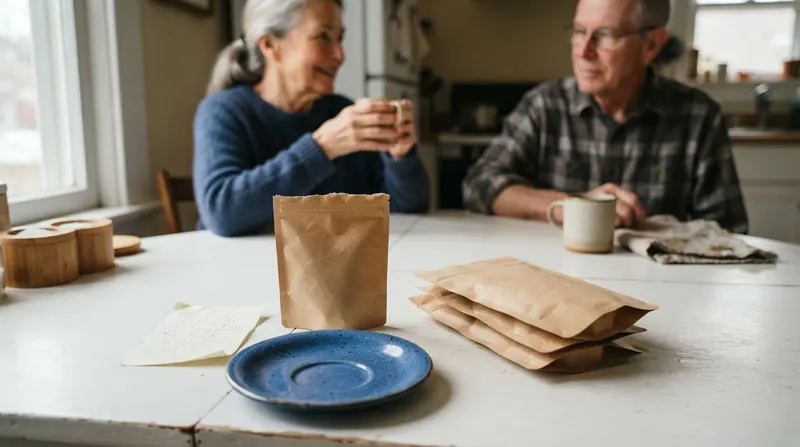
The Morning Routine, Step By Step
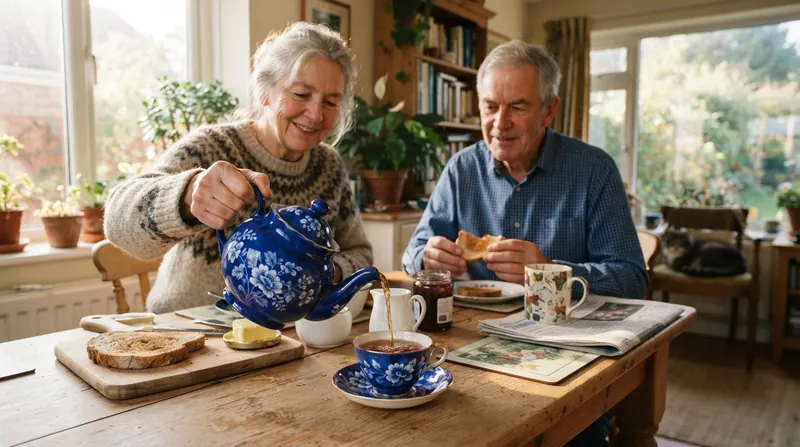
Ruth is a creature of habit, so I'll tell you exactly how it fits into her morning.
She fills her kettle the night before. That's a seamstress habit.
"Anything you can do the evening before, you do," she told me, "and then the morning's just the morning."
In the morning, she spoons the leaf into a stainless infuser and sets it in her cup. The bag has its own steeping directions, and she follows them rather than guessing.
She pours, she waits, and she butters her toast while it steeps.
Then she drinks it the way she drank her coffee: at the workshop table, with the pattern laid out in front of her.
That's the whole routine. One cup, one infuser, one rinse when breakfast is done.
She tells me she doesn't miss the second cup. What she means by that is hers to say, and I'm not going to turn it into a claim.
What I will say is that she's back to doing her beadwork in the morning. Make of that what you will.*
How I'd Make The Switch If I Were You
If you're reading this with your second coffee of the morning, I'm not going to tell you to pour it out.
Here's the sensible way to try a high caffeine tea, the way I walked Ruth through it.
Week one: swap the first cup only
Keep your routine. Just make the FIRST cup of the morning Blue Lady instead of coffee.
Follow the steeping directions on the bag. Don't double the leaf to "make it count."
The seller already positions it as high caffeine. [6]
Then pay attention to one thing: do you reach for the second cup at the usual time, or not?
Week two: count your caffeine
The FDA cites 400 milligrams a day as the amount not generally associated with negative effects in most healthy adults. [2]
One serving of Zest's high caffeine black tea is 150 milligrams by the seller's FAQ. [6]
That leaves room in the day.
It does NOT leave room for a cup of Blue Lady AND three refills of coffee.
Count, add them up, and stay under the line.
Week three: move the afternoon cup
Remember Problem #5. The afternoon cup is the one that steals from your night. [2]
If you still want something warm at 3 o'clock, make it something without caffeine, and keep the high caffeine tea for the morning.
That's the whole plan. First cup, count, protect the afternoon.
It is not complicated, and it is not a health program. It's a tea specialist's common sense.
Your First Week With Blue Lady, Cup By Cup
Nobody prepares you for what the first week is actually like. So let me.
Day one: the smell
The first thing you'll notice when you open the bag is the orange peel. Then something floral underneath it, from the hibiscus.
It does not smell like a "coffee replacement." It smells like a tea you'd be happy to serve to company.
Day two: the color
Give the leaf its full steep. A black tea this sturdy wants it.
The cup goes from pale gold to deep copper in the infuser. If you've only had tea bags, this is where loose leaf earns its keep.
Day three: the "where's my second cup?" moment
Around mid-morning you may catch yourself at the coffee pot out of habit, mug in hand, before remembering you didn't want it.
That reflex is twenty years of routine, not a need.
"Peg, I just stood there holding the mug like a fool," Ruth told me on day three. She'd stopped doing it by day six.
Day five: the taste settles
By the end of the week you'll know whether you like it. Most of the 1,593 reviewers on the seller's page apparently do, but your tongue is the only one that matters. [9]
If you don't, the seller's 30-day no-questions-asked policy means the bag can go back. [10]
Day seven: decide
At the end of the week, ask yourself one honest question. Did I miss the coffee, or did I miss the habit?
For Ruth, the answer was the habit. What that meant for her mornings is hers to tell, and I promised I wouldn't put words in her mouth.*
Four Things Coffee Drinkers Get Wrong About Tea
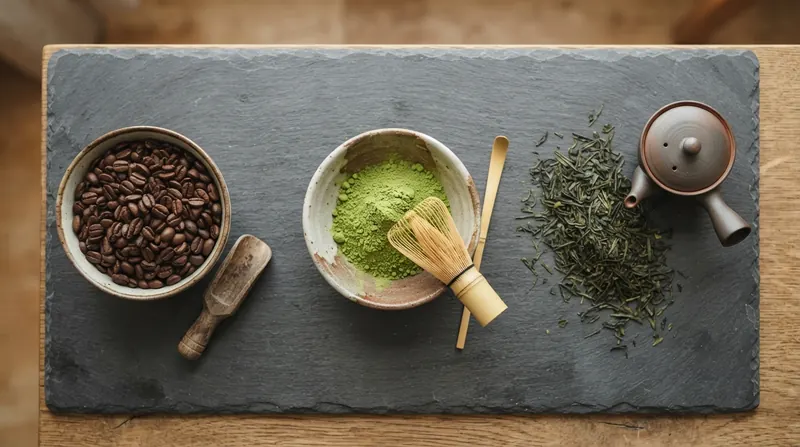
I hear these every week at tastings. Let me take them one at a time.
Myth #1: "Tea is weak."
Regular tea, yes. By the seller's table, a regular cup of black tea is around 50 milligrams of caffeine, less than half of a coffee's 120. [6]
A high caffeine black tea, by the same table, is 150.
That's not weak. That's the strongest cup on the chart. [6]
Myth #2: "Tea is for bedtime."
Chamomile is for bedtime. Chamomile isn't tea; it's a flower.
Real tea, from the Camellia sinensis plant, contains caffeine. [4] Black tea has always been a morning drink, from London to Calcutta, and it's the morning we're talking about.
Myth #3: "Loose leaf is fussy."
It's a spoon and an infuser. If you can make a pot of coffee, you can make a cup of loose leaf tea.
The only "fussy" part is rinsing the infuser, and that takes about as long as rinsing a coffee filter basket.
Myth #4: "If I want the L-theanine, I need green tea."
Same plant, same amino acid. Green and black are two ways of handling the same leaf. [4]
Green tea just doesn't bring the caffeine a coffee drinker is looking for. A high caffeine black tea does, and it brings the leaf's amino acid with it.
Is Blue Lady Right For You?
I'll be straight with you. This tea is not for everybody, and I'd rather lose a sale than sell it to the wrong person.
It IS for you if:
- You drink coffee for the lift and you're tired of the shaky hands and the afternoon slump
- You've tried regular black tea and found it too weak to replace your morning cup
- You like a bright, floral, fruit-forward cup rather than a plain malty one
- You already own a kettle and don't mind an infuser and a spoon
It is NOT for you if:
- You're sensitive to caffeine, or you've been told to limit it
- You're looking for a bedtime tea or a caffeine-light option
- You want a quick tea bag with nothing to measure (the seller offers the blend in bags too, but this page is about the loose leaf)
- You're hoping a beverage will do what only your health care provider can
If you landed on the first list, keep reading. The offer is just below.
Here's How To Get Blue Lady Loose Leaf Delivered To Your Door
The seller lists Blue Lady loose leaf in two ways: a single bag, and a three-pack. [9]
A single bag is listed at $22.95.
The three-pack is listed at $61.97, which works out to about $20.66 a bag. That's $6.88 less than buying three bags one at a time, by simple arithmetic.
Ruth started with one bag. I'd suggest the same if you've never had a high caffeine tea before.
If you already know you like a strong, floral black tea, the three-pack is the sensible way to buy it.
Blue Lady High Caffeine Loose Leaf Tea, by Zest Tea of Baltimore, Maryland
Shipping, tax and current availability are set by the seller's checkout, not by this article. Please confirm the total before you order.
Try it for 30 days, no questions asked
The seller's refund policy is short enough to quote in full: "We have a 30 day no questions asked return policy that starts the day your package arrives." [10]
Once they receive what's left of the package, they refund or replace it, whichever you choose, within 10 days. [10]
In other words, you can drink Blue Lady for a month and still send the bag back if it isn't your cup. That's the seller's policy, and it's on their refund page for you to read.
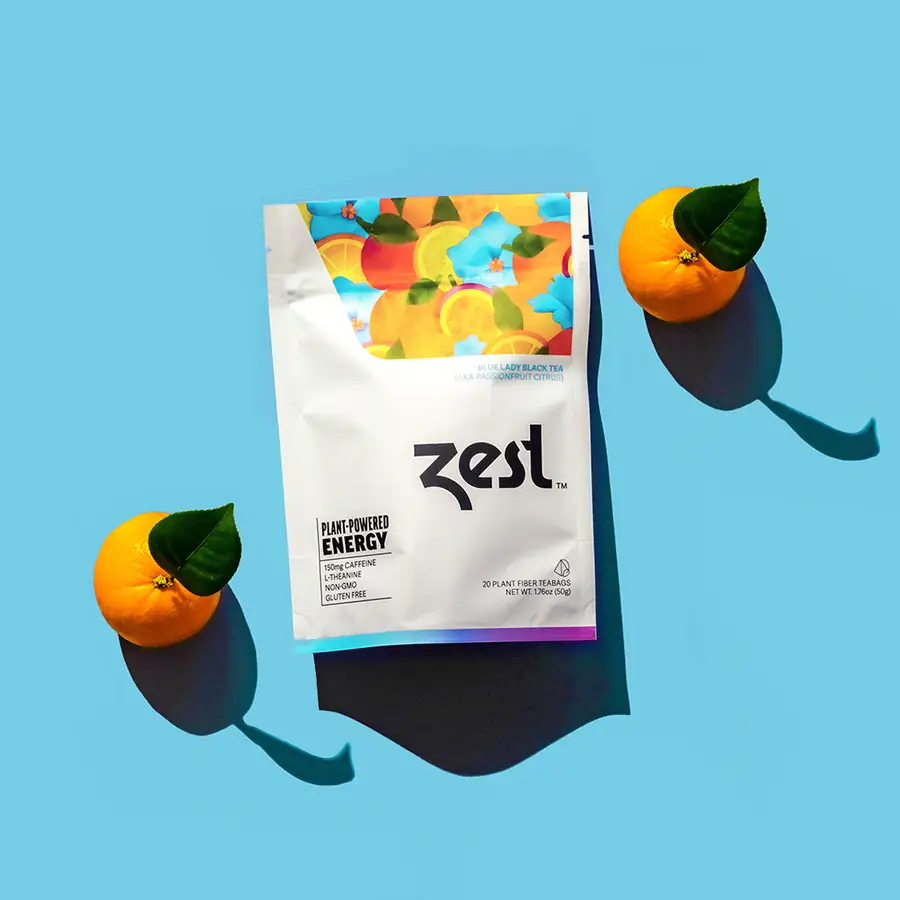
One bag, $22.95 as listed · 30-day no-questions-asked return policy · Sold by Zest Tea, LLC, Baltimore, Maryland
Why A Tea Specialist Is Writing About A Memory Worry
I want to end where I started: with that phone call from Ruth.
"Peg, I feel foggy till noon."
She didn't call a specialist. She called her sister, because that's who you call.
And her sister happened to spend her days with tea leaves, so the answer came in the form of a kettle.
But I want to be clear about what tea can and can't do, because I've spent eleven years watching people expect too much from a cup.
Tea can't do what your health care provider does. It can't check anything or sort anything out.
If the fog is new, or it worries you, that's a conversation for a professional, not a product page.
What tea CAN do is replace a morning habit that isn't serving you with one that might serve you better.
Coffee gave Ruth the lift and the jitters. A high caffeine black tea gave her the lift with the L-theanine that research keeps pairing it with. [3]
That's it. That's the whole trade.
A different leaf in the same kettle.
And if you've read this far, I think you already know whether it's a trade you want to make.
From one sister to another
Ruth doesn't read product pages. She reads patterns, hems and the occasional church bulletin.
So when I told her I was writing this, she asked me to put one thing in, in her words. Here it is.
"Tell them it's just tea. Tell them it tastes like oranges."
"And tell them to use the good cup."
That's Ruth. Forty years of weddings, and she still thinks the cup matters more than the leaf.
She's not wrong. The cup, the kettle, the table cleared for the pattern: that's the morning.
The leaf is just what you put in it. I've told you which one I put in hers, and why.
I used my mother's blue pot that first morning in April, chip turned to the wall. Ruth uses the good cup.
The rest is yours to decide, and the kettle is probably already full.
Questions readers ask
Is Blue Lady a supplement?
No, it's a loose leaf black tea, a food. It isn't meant for any health problem and this page doesn't claim it is.
How much caffeine is in a cup?
The seller's FAQ states 150 milligrams per serving for its high caffeine black teas, against 50 for a regular black tea and 120 for coffee on the seller's own table. [6]
What if I don't like it?
The seller's refund policy is a 30-day no-questions-asked return window that starts the day the package arrives, with a refund or replacement within 10 days of receiving the return. [10]
Is the L-theanine added, or is it in the leaf?
L-theanine is an amino acid found in the Camellia sinensis leaf that all black, green and oolong tea comes from. The seller pairs that leaf with a high caffeine positioning. [4]
What did the studies actually use?
Measured doses: 50 mg caffeine with 100 mg L-theanine in the 2008 crossover study, 200 mg a day of L-theanine in the 2019 four-week trial, and a single dose in the 50-to-69 study. None of them used this tea. [3]
Is it a tea bag or loose leaf?
This page is about the loose leaf bag. The seller also sells the blend in tea bags, which is the version one reviewer above mentions.
What does it taste like?
By the seller's description, an orange pekoe black tea base with orange peel, lemon, passionfruit and hibiscus. One reviewer compares it to Earl Grey. [9]
How do I brew it?
Follow the steeping directions printed on the bag. Use an infuser or a teapot with a strainer, and don't guess at the amount.
Can I drink it in the afternoon?
It's a high caffeine tea. The FDA lists sleep disruption among the things too much caffeine can bring, so an afternoon cup is a personal call. [2]
Should I check with anyone before trying it?
If you take medicines, or if caffeine has ever disagreed with you, the FDA advises talking with your health care provider. [2]
Where is the company?
Zest Tea, LLC, Baltimore, Maryland. Contact details are on the seller's contact page and on this page's contact link. [11]